SDG 5: Gender Equality
Achieve gender equality and empower all women and girls
Westminster International University in Tashkent (WIUT) is committed to equal opportunities for women and men in study, work and research. Its Diversity and Dignity Policy protects all students and staff from discrimination, and its Admissions Policy ensures fair and equal access. The University's Development Strategy 2025–2035 commits it to ensuring gender balance in the workplace.
In 2025, women made up 43.3% of WIUT's 487 academic, administrative and professional staff (211 women). Female faculty members authored 40% of the University's 234 publications. WIUT researchers study gender equality in education, employment, agriculture and leadership, both in Uzbekistan and beyond.
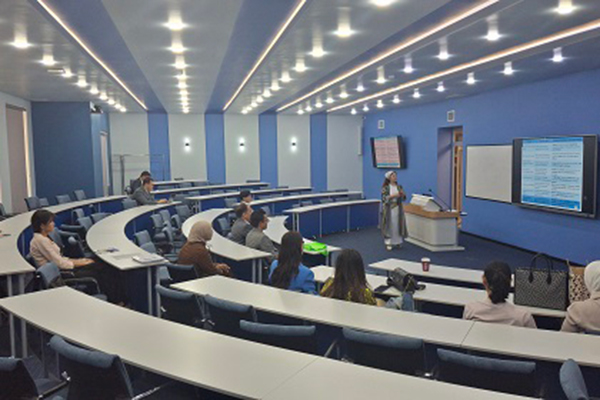
Empirical Analysis of Gender Differences in Environmental Decision Making
On October 15, 2025, the School of Business and Economics hosted a research colloquium featuring Sarvinoz Mamadjonova, a PhD candidate in Econometrics and Statistics. She presented her study titled "Empirical Analysis of Gender Differences in Environmental Decision Making."
The research provides a comprehensive investigation into how factors related to gender equality and women's economic and political empowerment influence environmental performance at both the enterprise and country levels. Despite the global focus on sustainable development, empirical evidence linking gender-inclusive governance to concrete environmental outcomes has been limited.
The presentation offered valuable insights into the critical role of gender-inclusive policies in achieving sustainability goals and will likely spark an engaging discussion on the intersection of gender equality, governance, and environmental management in Uzbekistan and beyond.
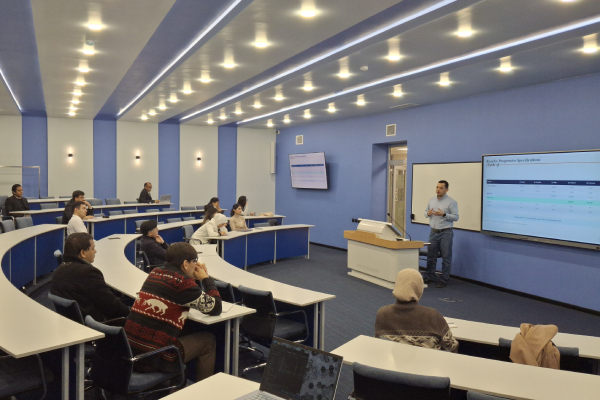
Female Leadership and Innovation in Emerging Market SMEs: Causal Evidence from Lower-Middle Income Countries
PhD candidate in Management Abbos Azizov presented causal evidence, based on data from 44,193 SMEs in 43 countries, that female leadership increases the likelihood of SME innovation by 5.97 percentage points. The effect appears only where legal gender equality is stronger, underlining the importance of institutional support for women entrepreneurs.
TIMUN 2025: Central Asia’s Largest Model UN Conference Brings Together Future Leaders
Over the course of three dynamic days, TIMUN 2025 — the Tashkent International Model United Nations Conference — brought together more than 400 young delegates from Uzbekistan and abroad. The event was hosted by Westminster International University in Tashkent, in collaboration with UN agencies in Uzbekistan, the Youth Affairs Agency of the Republic of Uzbekistan.
Held under the theme “Together for the Future, Together with Youth,” the conference simulated eight UN committees, addressing urgent global topics such as:
Peace and security through preventive diplomacy
AI and the future of youth employment
Green energy and sustainable development
Gender equality, education, and global health
Throughout the event, delegates demonstrated diplomacy, critical thinking, and a shared commitment to international cooperation. In addition to committee sessions, participants engaged in workshops, cultural exchange, and peer networking.
Publications
Nasimova, S. (2025). Determinants of Female Literacy Rates: Evidence from Cross-Country Panel Data. Economics and Society. https://www.iupr.ru/_files/ugd/b06fdc_83772b2693b04da19843f28f339d852b.pdf?index=true
Alimukhamdeova, N., Tokhirova, N., Zakhidov, A., Nurmatov, A., Basyoni, A., Abdullaeva., L., Aganova, V., and Latypova, V., (2025). Female Students' Aspirations and Study in U.S.: Voices of Gen Z From Uzbekistan. The Midwest Quarterly a Journal of Contemporary Thought. Pittsburg State University.
Egamberdiev, B. et al. (2025). Women’s Empowerment for Farm Resilience in Ethiopia: A Three-Step Approach for Latent Class Analysis. Review of Agricultural, Food and Environmental Studies. https://doi.org/10.1007/s41130-025-00243-2
Bilal, M. and Usmonova, G. (2025). Delaying Motherhood: Behavioral and Socio-Demographic Determinants of Early Childbearing in Tajikistan. Green Economy and Development https://yashil-iqtisodiyot-taraqqiyot.uz/journal/index.php/GED/issue/view/68
Kiran, P. et al. (2025). The Role of Higher Education Institutes (HEIs) in Reducing Gender Inequalities. In Grover, P., Phutela, N. and Singh, P. (Eds), Higher Education and SDG10: Reduced Inequalities. Emerald Publishing Limited. https://www.emerald.com/books/edited-volume/17723/chapter-abstract/96837182/The-Role-of-Higher-Education-Institutes-HEIs-in?redirectedFrom=fulltext
Bilal, M., Djanibekov, N. and Tadjiev, A. (2025). Mechanizing Cotton Harvesting in Uzbekistan. CPRO Policy Brief 2025-01. The brief highlights the need for transition measures to protect female rural workers.
Student access measures
Women's progress measures
To read the full report on the SDGs for 2025, please follow this link.