SDG 12: Responsible Consumption and Production
Ensure sustainable consumption and production patterns

Energy Efficient Appliances Usage
WIUT pays great attention to energy saving. The energy saving directions / instruments include use of energy-efficient appliances, implementation of smart buildings/automated buildings/intelligent buildings, green building elements, greenhouse gas emission reduction policies and carbon footprint. At the policy level, activities for further years include renewable energy policy, overall electricity consumption energy saving programs, climate change adaptation and mitigation programs. The campus and dormitory buildings are equipped with solar panels. All lights are transformed into LED systems, with motion and light sensors where applicable.
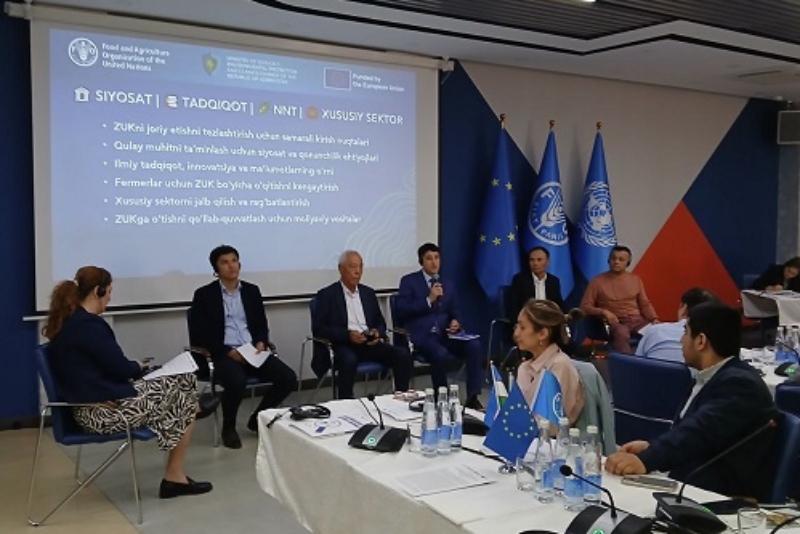
Advancing Sustainable Agriculture in Uzbekistan
On 16 April 2025, Westminster International University in Tashkent (WIUT) proudly hosted the National Workshop on Promoting Alternatives to Highly Hazardous Pesticides (HHPs)—a significant milestone under the GCP/UZB/017/EC project, supported by the European Union (EU). The workshop brought together over 30 representatives from government agencies, academia, civil society, and international organizations to discuss practical strategies for transitioning toward Integrated Pest Management (IPM) and reducing reliance on hazardous chemical inputs in agriculture.
The event concluded with the establishment of a multi-stakeholder IPM Working Group, tasked with developing a National Action Plan and advancing education and training initiatives.
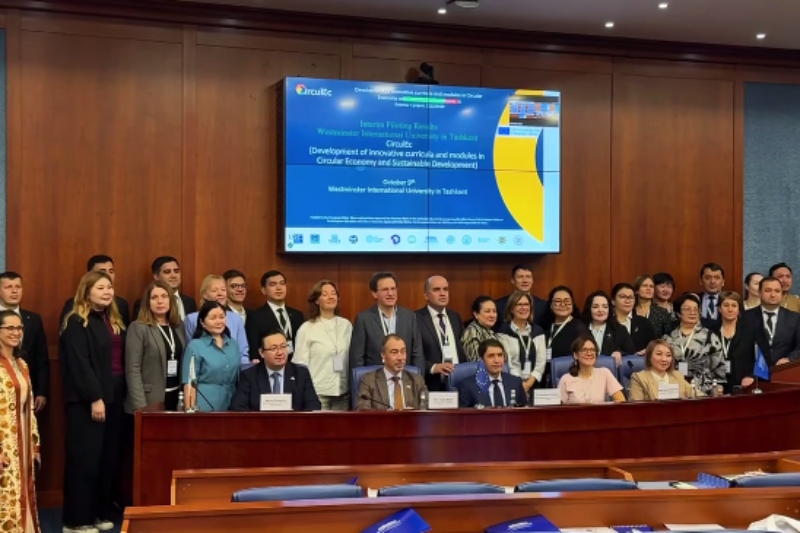
Monitoring Meeting on Erasmus+ CirculEC Project
Westminster International University in Tashkent (WIUT) hosts the monitoring meeting for the Circular Economy project funded by Erasmus+.
Rector Dr. Komiljon Karimov and His Excellency Toivo Klaar, EU Ambassador to Uzbekistan, opened the ceremony.
As a part of the event, WIUT brought together over 50 professors and experts from Central Asian and European HEIs to review the project’s progress. Zamira Ataniyazova, Iroda Komilova, and Murrodullo Bazarov presented WIUT's contributions in integrating concepts of Sustainability into educational programs. The distinguished guests include Akmal Rustamov from EEAS and Aziza Abdurakhmanova, Coordinator of the National Erasmus+ Office in Uzbekistan.
Publications
Hossain, M.B., et al. (2025). The Green Supply Chain Conundrum: Exploring the Interplay of Practices, Performance, and Technology in Shaping SME Sustainability in Developing Country. Environment, Development and Sustainability. https://link.springer.com/article/10.1007/s10668-025-06614-5
Kumar, A., et al (2025). Turning Trash Into Treasure: Optimization of Innovative Solid Waste Management Solutions for Puri, Odisha. In Albattat, A., Singh, A., Tyagi, P. K., & Haghi, A. (Eds.). Solid Waste Management for Rural Regions. (Chapter 21). IGI Global Scientific Publishing. https://www.igi-global.com/gateway/chapter/363994
Mirkasimov, B. and Razhabova, S., (2025). Assessment of hidden costs in agri-food value chains in Central Asia. Economy: Analysis and Forecasts, (pp. 38) https://imrs.uz/journals/29
Alimukhamedova, N., Ismailov, J., and Abdullaeva, L. (2025). Small Intervention, Big Impact: Experimental Evidence on Behavioral Change Towards Rational Use of Water and Energy in Uzbekistan. CPRO Policy Brief 2025-05-01. https://doi.org/10.70735/CZLD5460
To read the full report on the SDGs for 2025, please follow this link.